It’s no secret that there are shortages and uncertainties in the import/export world occurring all around us. Tariffs, geopolitical posturing, active bankruptcies, incompetence, misallocation of capital and wars have real consequences. These consequences are equivalent to a tidal wave that modifies everything in its path; some for the bad, some for the good (if you’re clever enough before hand).
I believe that there is an opportunity shaping up (fortunately or unfortunately) that entails antibiotics. We’re now coming across conditions that resemble the Great Depression (absolute poverty, lack of employment, debts coming home to roost while the currencies are strengthening and equity markets are losing steam, not to mention the larger political behaviors of using nationalistic rhetoric for the induction of tariffs and scapegoating others).
During the Great Depression, medicine imports in particular to the U.S. were significantly impacted by the Smoot-Hawley Tariff Act of 1930, which raised taxes on imports leading to a decline in international trade. While imports were already decreasing due to the economic downturn, the tariffs worsened the situation and made some foreign-produced medicines more expensive or less available.
Fast Forward
I have written plenty of the monopoly that China had positioned themselves with respect to refining and mining of critical minerals and rare earths–>>>https://statespeculator.substack.com
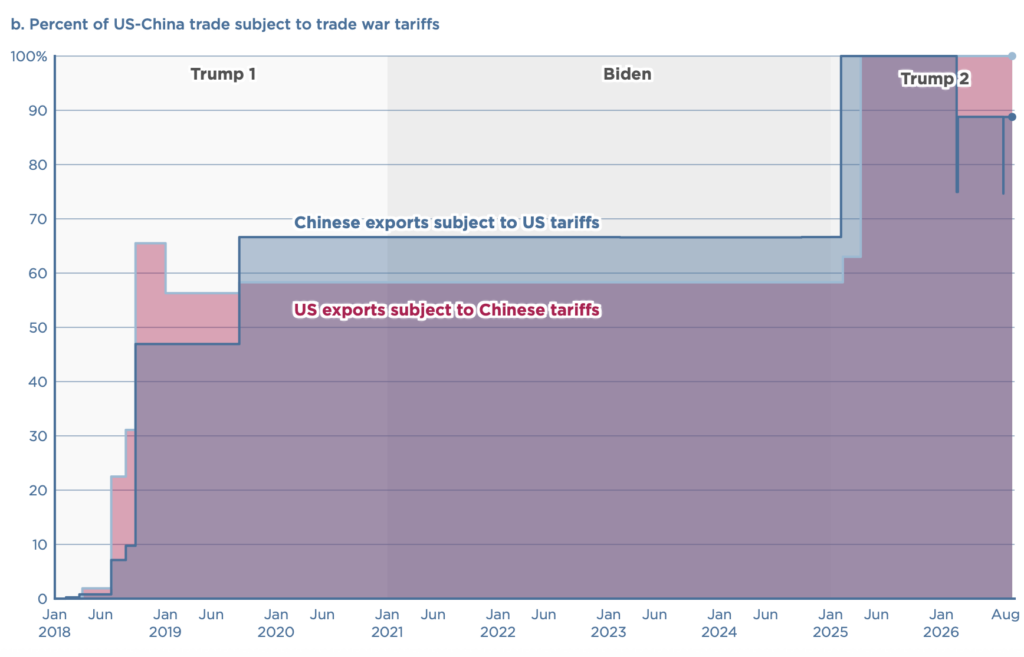
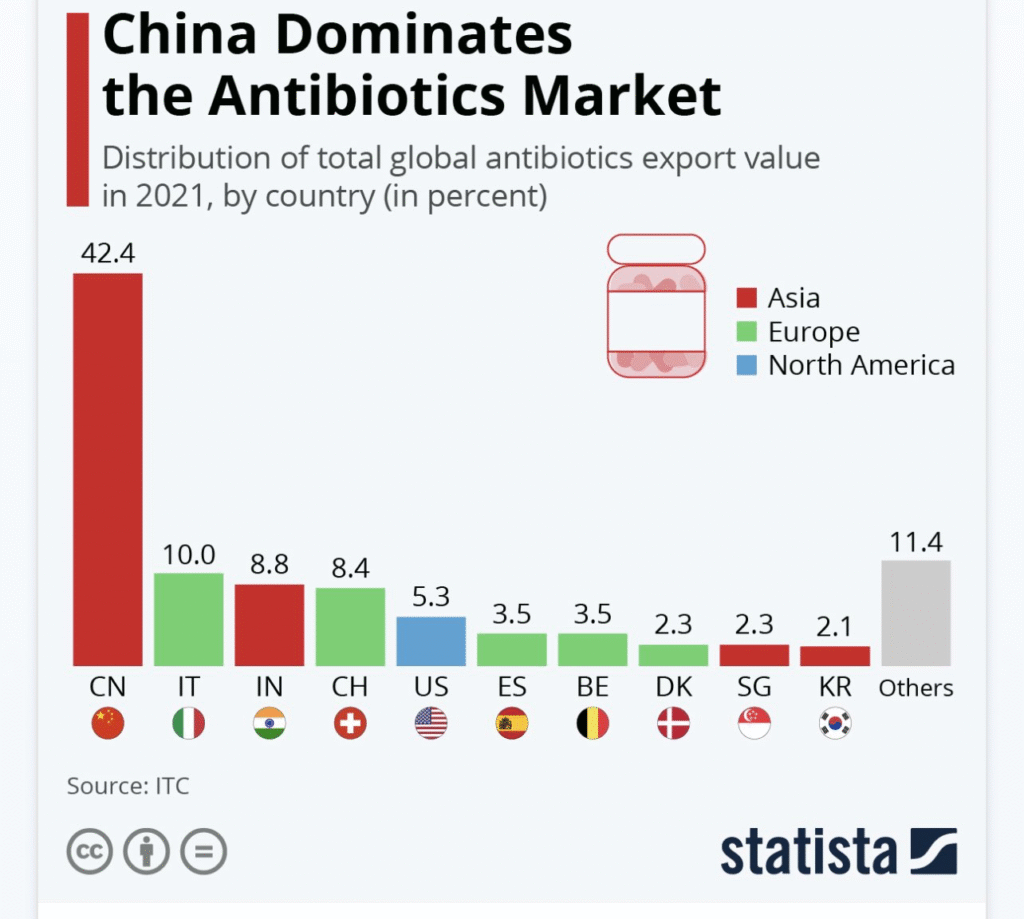
However, China has another near monopoly on something else that are critical to our day-to-day living. Antibiotics. And we just so happen to be in an economic and trade war resembling the Great Depression.
By JAMA Health Forum, US Antibiotic Importation and Supply Chain Vulnerabilities, we can see some interesting vulnerabilities of the antibiotics market and its amazing volatility over the last 40 years. In this study, they examined cross-sectional studies analyzed between 1992 to 2024 of antibiotic importation records and found 50 originating countries of finished dosage forms (FDF) and 52 countries for active pharmaceutical ingredients (API). The former being the actual product, whereas the latter requiring the product to be produced locally.
Compared with the annual volume of US antibiotic FDF imports in 1992, the annual volume in 2024 increased 2595.0% (yes read that again…), while the annual volume of API imports remained relatively stable.
They found that US antibiotic importation relies on diversified global sources for FDFs but primarily on China for APIs (around 2/3rds of all supplies). They later encouraged to immediately strengthen domestic production and diversify sourcing are critical to mitigate supply chain vulnerabilities.
Examples
Amoxicillin (e.g., Amoxil®) – 90%+ APIs from China; tops US prescriptions (30% of antibiotics). No full domestic production until recent efforts.
• Doxycycline (e.g., Vibramycin®) – 100% key materials from China; vital for Lyme, acne & bioterror response.
• Penicillin – 40-45% imports, 90%+ APIs Chinese; broad-spectrum staple.
• Erythromycin – Limited US/India production; heavy Chinese import reliance.
• Streptomycin – 100% US API files from China; treats TB & plague.
• Tobramycin (e.g., Tobrex®) – 100% APIs Chinese; for eye infections & cystic fibrosis.
• Gentamicin (e.g., Garamycin®) – 100% APIs from China; hospital essential.
• Cephalexin (e.g., Keflex®) – 70-90% cephalosporin APIs Chinese; common for UTIs & skin infections
Scary enough, there are 288 critical medicines listed and recognized by international medical organizations, and a large chunk of these, are antibiotics.
Review Here: https://www.sefh.es/fichadjuntos/union-list-critical-medicines-version-1_en.pdf
Importance of APIs
Most antibiotics are unpatented generic drugs or “no name” brands, which allows multiple global manufacturers to produce the same drug. However, even when the manufacturer of a finished dosage form (FDF) is identified, the source of its active pharmaceutical ingredient (API) often remains uncertain. APIs—the substances that provide a drug’s therapeutic effect—are the most important components of generic drug production, which is exactly why China positioned itself as being the leader in its production.
“The China active pharmaceutical ingredient (API) market is valued at approximately USD 17.22 billion to USD 23.05 billion and is projected to reach USD 25.13 billion to USD 37.22 billion by 2030–2031, growing at a compound annual growth rate (CAGR) of roughly 7.8% to 9.0%“
Can a ramp up occur?
From outsourced pharmacy, who appear optimistic in efforts to reshore companies to US, domestic production costs have traditionally and stubbornly been higher than those overseas. Local, state, and federal building and regulatory compliance is also a concern in being able to scale rapidly. So is finding and maintaining a reliable workforce.
Commitment to invest sounds fantastic but once you zoom in further you see that it’s not so simple.
95% of the ingredients used to make antibiotics come from China [EVEN for Indias production]
No bypassing
The United States could buy a finished antibiotic from an Indian manufacturer, or from a European manufacturer, and still be exposed to a disruption in China.
The Council on Foreign Relations highlighted this problem in its 2026 report on pharmaceutical supply chains, including the dependence of amoxicillin production on Chinese starting materials even when the final ingredient is manufactured elsewhere
Speaking about antibiotics...did you see this stock write up???
Biological Compounding
Shortages with antibiotics are particular sinister given the nature of how the drugs operate. Similar to how I wrote about fentanyl, compensatory responses and Bitcoin mining, the very characteristic of the subject leads to complications in trying to solve problems associated with it. It becomes a snowball effect that gets larger and larger.
Antibiotic shortages often lead to the overuse of specialized or emergency-reserve antibiotics (similar to how the fear of gas shortages lead to gas shortages), which impacts the treatment and increases the risk of drug resistance, making infections harder to treat over time. One thing I managed to learn in my overpriced university degree was that antibiotics aren’t bacteria killing drugs, rather, they are selective drugs that only kill the bacteria that are non resistant to the compound present. Meaning that overuse of antibiotics can create an environment where you only control for bacteria that are resistant to the drug. Hence, an inability to treat them at all.
These medicines have been incredibly deflationary. That’s why nobody is paying attention
Mean inflation-adjusted importation prices for FDFs decreased from $1836.03 per kg in 1992 to $177.44 per kg in 2024. For APIs, mean prices decreased from $351.74 per kg in 2003 to $65.69 per kilogram in 2024.
This has created an interesting market dynamic if we fast forward into 2026 and beyond. Over the last decade, specific off-patent generics have spiked drastically in price—some by 90% to over 500%. This happens because manufacturing antibiotics is a low-profit venture. When generic manufacturers pull out of the market due to low margins, it leaves a monopoly or duopoly. The remaining manufacturer then raises prices simply because they can.
More serious where antibiotics are truly getting “more pricey” is in the treatment of antimicrobial resistance (AMR). Because bacteria have adapted to older drugs, newer generations of antibiotics (like oxazolidinones) are required. Developing these drugs is highly expensive, but doctors use them sparingly to prevent bacteria from building resistance. Because volume is low, drug companies set astronomical prices to recoup costs
IF you like this unique, contrarian content, please consider subscribing as a tool to aid your investment and business portfolio as we navigate these tough times. I also invest for clients personally, too, using a different accredited company.
Prior Supply Chain Concerns
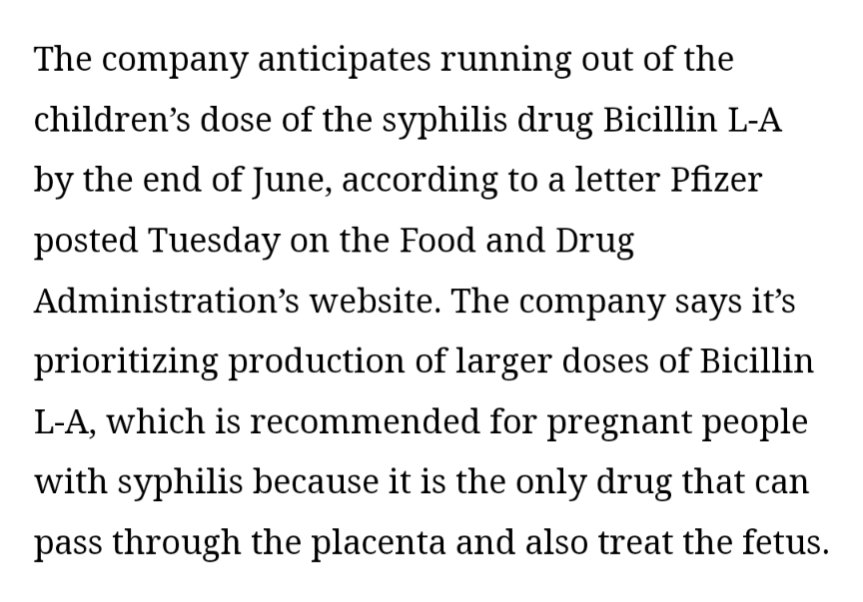
FDA Declares Nationwide Amoxicillin Shortage (Headline).
European Union opted against designating antibiotic shortages as a “major event” as that labeling would empower the European Medicines Agency to orchestrate a unified response at the pan-European level (2023)
https://writesoapbox.com Start Writing TODAY!
Closing
Put bluntly, the saying if China sneezes the world catches a cold could be thought of as having two meanings.
Antibiotics are a medicine that we cannot live without–and the world has let China takeover a monopoly on this extremely important sector with no easy solution by simply going to another manufacturer.
As of now, the pendulum of pricing has gone from a massive cut in pricing to now a situation where it’s picking back up as a result of monopolized markets and antibiotic resistance that are cumbersome to develop (& doctors reluctant to utilize). This happens to be a perfect trend if you are China viewing the USA as an adversary who will be forced to buy more and more expensive APIs.
In the event of a real crisis, we can assume that these drugs we take for granted can fall by the wayside and cause a real amount of destruction that few people are currently expecting. I believe this is an investment thesis in the making.
