Trending Sectors
If you’re locked in the algorithm that I am in, everyday you’ll be inundated with lots of statistics, charts and experts on podcasts talking about the bull-run in commodities. If you ask me, there’s enough data out there to justify putting all your money into a copper or tungsten related company alone (though extremely risky and not very prudent)–however there’s one aspect that is never considered because it requires a longer time to appreciate.
People.
People is one of Doug Casey’s 9 P’s when it comes to screening whether a mining stock is a viable investment or not. Except rather than evaluating the quality of people (as this is commonly referred), I wanted to right about an aspect that rarely gets talked about–the quantity of people [in mining].
Here are three items to keep an eye on with respect to people and the resource mining space
1. Contributions vs. Redemptions (Of People)
Major mining CEOs have resigned or retired in Q4 2025 The mining industry is going through a major shift
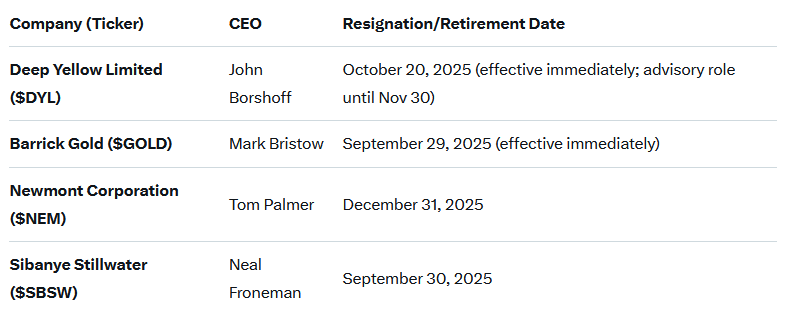
| Amanda Lacaze | Lynas Rare Earths | End of June 2026 | 63 years of age |
| Graham Kerr | South32 | June 30, 2026 | 55 years of age |
| Randy Smallwood | Wheaton Precious Metals | Mar 31, 2026 |
Young Blood is Not Joining as Fast
Nearly half of mining engineers are expected to hit retirement age within a decade, the average U.S. mine worker is 46. In the UK, 80% of registered mining engineers are over 50 with 40% already past 60. Meanwhile the inflow has been shrinking, not just aging out: enrollment in mining engineering programs has fallen more than 60% since 2014 in some markets, and in one global survey, only 4% teenagers are enthusiastic at all about mining. That’s a genuine hourglass shape — a large, aging cohort at the top with a thin base beneath it.
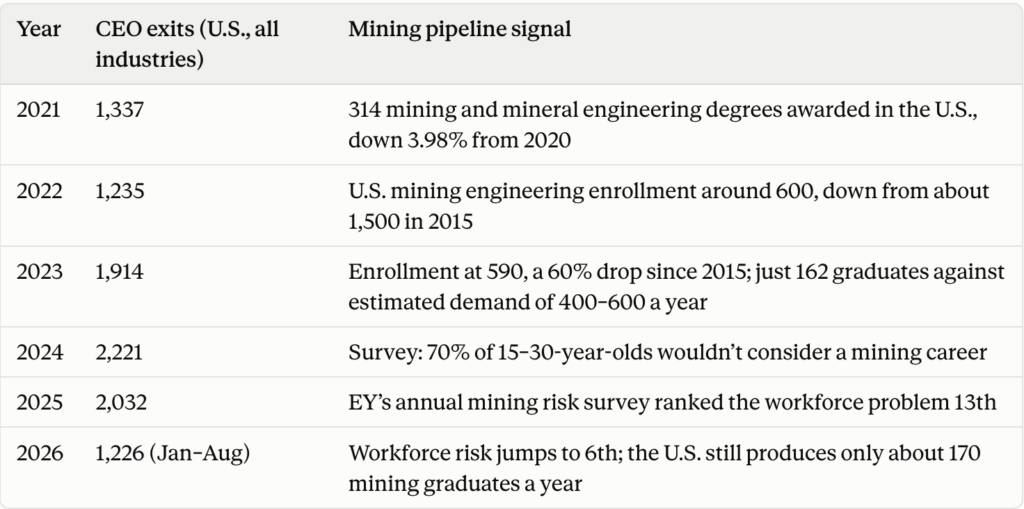
Colorado School of Mines has projected that more than half of the U.S. mining workforce — roughly 221,000 workers — will retire by 2029
Let's plan for the long-term.

Let’s Start a Global Macro Portfolio to Take Advantage of the Trends
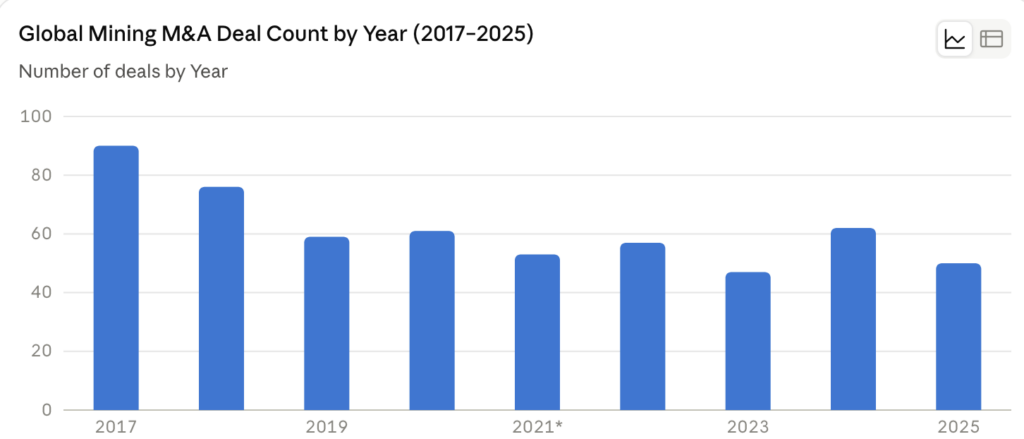
2. M&A is happening, slower but professionals come with it
When BHP acquired contractor HWE Mining over 10 years ago, becoming an owner-operator through acquisition was advertised as a lower-risk path than trying to replace HWE’s highly skilled, long-serving workforce through direct recruitment. Even back then, functionally, a labor acquisition wearing an asset deal’s clothes was seen to be strategic. Acquisitions does come down to the package of highly-skilled, experienced teams available that goes hand in hand with such assets they’re interested in exploring.
Mining M&A hasn’t slowed so much as concentrated into fewer, larger deals. Deal value hit $21.6 billion in Q1 2026, the strongest start to a year since 2023, and S&P Global counted its second-highest quarterly total on record even as transaction counts fell. I saw the trend firsthand as a Sandstorm Gold shareholder: Royal Gold acquired Sandstorm in an all-stock deal that closed last October, and my shares became RGLD.
Despite a recent pullback, record gold prices are the fuel. Barrick generated $4.3 billion in operating cash flow in the first half of 2026 and held $5.9 billion in cash by June, which makes development-stage juniors look cheap. Juniors with projects near existing infrastructure are the obvious targets, since buyers can bring them into production faster. Seniors need growth because reserves are hard to replace, while juniors face a choice: issue shares to fund construction, or sell at a premium while prices are high. More are choosing to sell. The point being here, with the industry short on experienced engineers and managers, an acquisition also buys a working team, not just ounces and cash flow.
3. More Mining Requires More Hands
Most of the bullish figures surrounding increases in required mining output are enormous, a doubling output within a relatively short period of time.
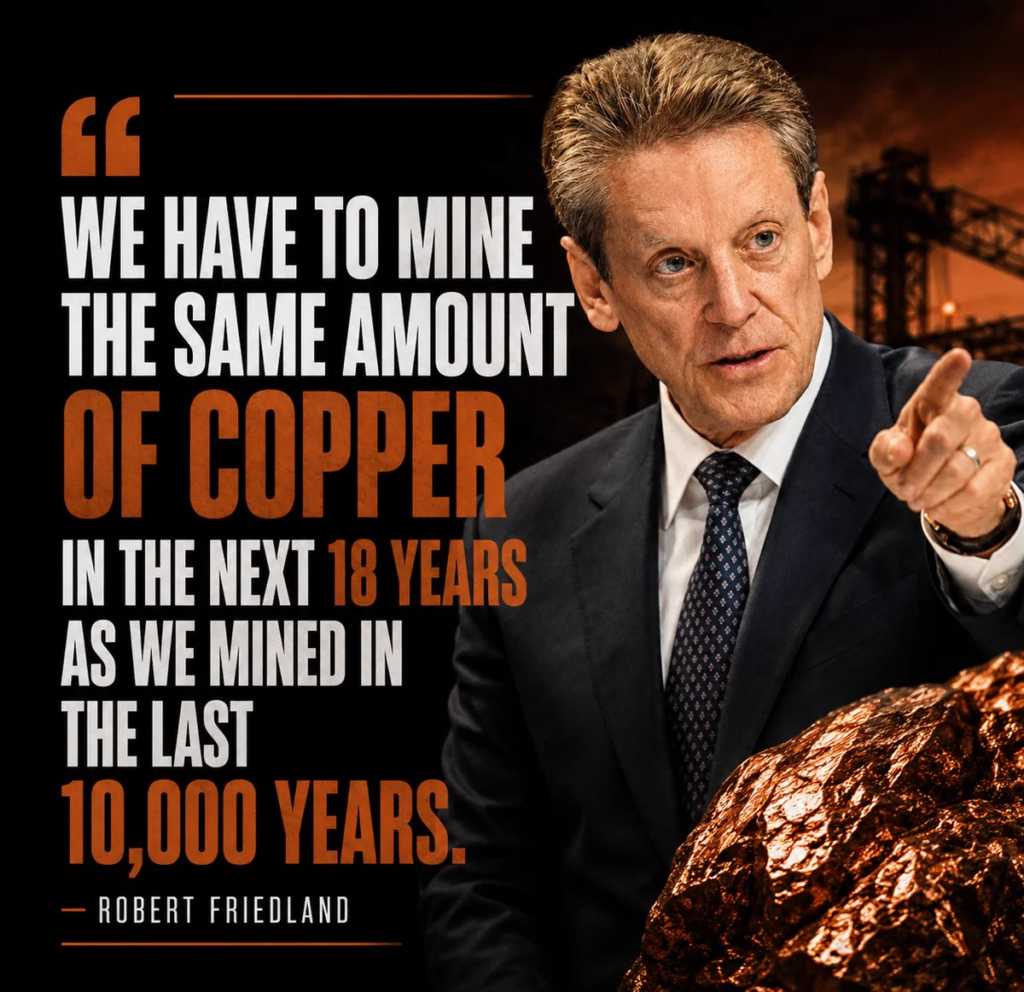
Multiply the tonnage, and you’re implicitly multiplying the headcount needed to pull it out of the ground. However, it’s not clear exactly where you’re going to get the hands nor the expertise to scale this effectively.
Real Numbers, Real Consequences
It’s already translating into physical constraints, not just a talent-market inconvenience. This is the part that validates the “physical shortage” of people leap. Approximately 71% of mining leaders in a McKinsey survey say the talent shortage is actively hampering their ability to hit production targets and strategic goals and 86% say “recruiting and retaining people is harder than it used to be”.
EY’s 2026 survey of 500 senior mining executives found that 75% aren’t confident they can resolve on-site labor shortages at all. Zero confidence. In all probability they are happy with the macro setup, with their geology and how the drills are turning and even their executives–but the majority are not confident that they can locate the know-how for this niche industry for on-the-ground.
This shows up concretely — several major British Columbia projects, famous to the gold mining world are already facing delays not tied to permitting but as a result of skilled labor shortages, with operators reporting production cuts and postponed expansions.
Even in Africa, those who are quick to promote their resource rich projects and rare earth opportunities such as Zambia’s copper sector, skills bottlenecks are reported to be stretching project timelines by 18–24 months. Ontario is seeing similar project delays and scaled-back expansion plans for the same reason
In fact, I specifically wrote about a gold mining company that had fantastic relations with artisanal miners in Nicaragua and Colombia which has been extremely well for On The Ball readers. Contact me to find out what the company is.
Automation will solve it?
A 2026 study found autonomous haulage and remote operations centers haven’t actually shrunk mining head counts — as with most innovations, they’ve simply redeployed workers from pits and underground into controller and analyst roles.
Even to the extent that new jobs are created in the sector, those roles need data science, automation, and remote-operations skills, which are arguably even scarcer than traditional mining trades, and as you can imagine, mining competes poorly for that talent against lucrative tech and energy industries. Why? Due to the familiarity, magnitude and they are sectors where you can move to a city with a comfy penthouse, not rural Yukon in a camp. So automation reshapes the shortage rather than resolving it.
Closing
It’s no secret that the figures comparing supply and demand are extremely favorable for commodities on the whole, some more than others. However, we have a disconnect that is worth watching here. It’s the number of qualified people in the mining sector. Right now we have less interest coming up relative to the number of those retiring, a situation where M/A may be occurring simply for one’s unique understanding of the geology and a lack of nippers (as they say in Australia).
Production guidance, feasibility studies, and national minerals strategies stress-test grade, price, and permitting risk almost by default. Almost none of them stress-test whether the people who run the mill actually be around and knowledgeable to fill the gaps necessary.
What do you think of this article? Do you think this will manifest itself in a bad way?
Are properties that are difficult to understand, develop and model at the risk of being ignored (which means a lot of investment capital gone to waste) or will the mining sector prevail in the end? Let me know! Join as an On The Ball member if you’re an investor.
