
Know the Laws Before Acting
On The Ball also supports individuals with their international strategy planning under the brand of Open Door Consultancy. Under here, I advise clients on their long-term plans, 2nd residencies, travel advice, citizenship matters, setting up offshore entities, jurisdictional compliance and tax concerns.
- Finance/Geopolitics
- Global Chaos
- Investment Powerplay
- Macro/CountrySpecific
- Open Door Category
- Weekly Weigh In
- Writer's Journal
I can say that I have incorporated a number of companies, assisted others to do the same and had numerous calls with corporate service providers and lawyers all over the world ranging from normal company setups to complex funds or complicated structures to mitigate tax and liability or custody-related matters. I can also say that I have tried to explore and get some business project ideas off the ground in both Mexico and Paraguay but simply decided to pull the plug before getting too deep with further disappointment and headache. I only say this to add credence to my argument below (and to offer my services to you if you believe I can assist you and your own plans!).
Big Picture Trend
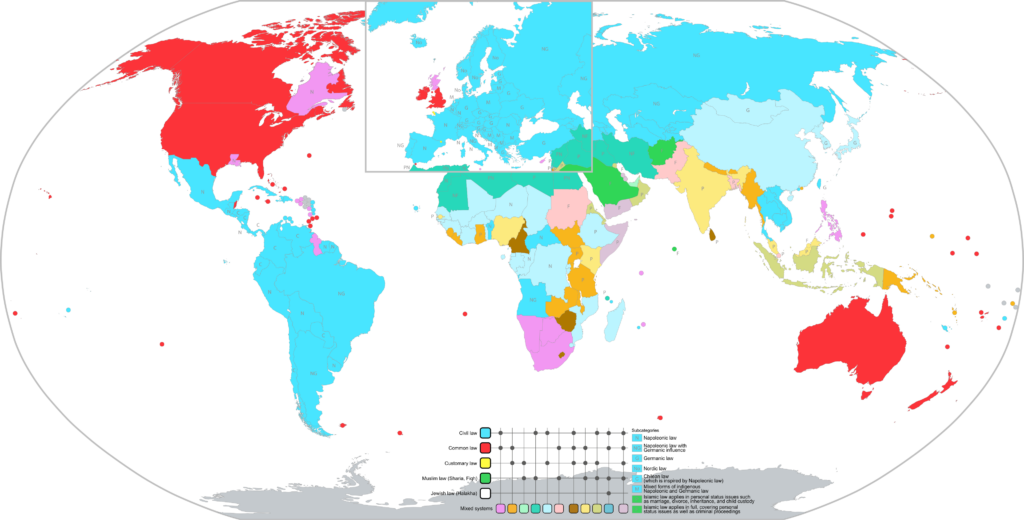
My unofficial, unprofessional legal analysis is that this diagram below (colorful globe photo) is an explanation of why so much capital remains in areas that are increasingly more punishing towards wealthy individuals. We can largely categorize this as being a Western friendly vs. Eastern friendly divide.
Why? Because…Common Law is just…superior.
Sorry to those who I’ve offended with this, but this is hardly covered to any depth. I have the strange experience about spending significant times looking not only into corporate laws in different jurisdictions but also their regulations to do the same activity (in what I can generalize as being “lucrative” industries). But you don’t need to take my word for it. Look at the where the wealth resides and it continues to have a Common Law relationship from the British Empire. Singapore and Hong Kong are two tiny places in Asia that are immensely wealthy for their size and look at their legal origins vs. their neighbors. Have a look at Panama, a US-created country vs. Colombia. Consider the difference between Jersey and France, a distance that an endurance athlete could swim between. Bottom line, those who were born out of origins that differ from Common Law (Switzerland is the only exception? but that’s going to the dogs…) I don’t know if the other systems have the bones to hold everything up.
Open Door Consultancy Comment
- Cook Islands–Trusts
- Jersey–Foundations
- Cayman Islands & BVIs–Funds
- Bermuda–Insurance
- Marshall Islands–Shipping Registry
- USA–Start Ups
- Singapore/HK–Asian Family Wealth
All of them have a general categorization handling multiples of billions of dollars every minute–the same specialization does not exist in the Spanish speaking or much of the European world. This is particularly noteworthy because Europeans, on a globally relative basis are still very wealthy, yet their laws are antagonistic towards storing wealth in that location.
Civil Law
Civil Law is often empty, contradictory and utilize a “one size fits all” codification which stifles innovation & new modeling. Civil law reliably favors centralization executed through mandates whereas Common law favors decentralization via private agreements and shareholders/property owner rights. Civil Law welcomes an environment of uncertain enforcement; a ‘grey area’ legal landscape that invites those in high places or those connected to benefit from selective justice. If you think this is harsh, look anywhere in Latin America—lawyers can always fall back upon the “good faith” principle.
Civil Law is bureaucratic, rigid with state regulations and unpredictability—the antithesis of a happy home for wealth.
Some Example of Dozens
The Tax law: clearly contemplates non-bank/non-casa-de-cambio persons selling precious metals as being free and unregulated. Meanwhile, Central Bank Law: says only Mercado de Cambios participants may habitually and professionally perform precious-metal purchases/sales.
“Companies that professionally act must be regulated, those who do not, are not regulated–and you guessed it…” There’s no legal definition of what “professionally acted” is in law
Or another I found...“gold qualifies when, “by its nature,” it is apt to serve as a means of payment — without spelling out a fineness percentage, bar weight, or brand list anywhere”--“by its nature” is not legally defined.
On tax law changes, “how the foreign tax credit actually works when income passes through an interposed entity, for instance — are flagged in professional commentary as not yet expressly settled in the law itself”
Entirely contradictory laws that do not easily fit in with another is the norm in Civil War–leaving an element of interpretation and corruption on the table for serious matters. Whoever has the largest wallet to have the biggest lawyer, has the best case of arguing in their favor. And I say again, if you believe I’m being dramatic, you should go to Mexico.
I know of a legal purchase case where the contract was void but the “good faith” principle had priority over the written and agreed to terms. How can anybody rely on their contracts?
Trend
I believe this is going to matter a great deal in the next decade or so when capital is on the move. Even though it’s clear that Westerners are moving to areas to preserve their freedom from bad policies and dystopian control mechanisms, they are still not relocating their major assets, major business operations or innovating in their new local places.
Rather they are operating from abroad or living off of their foreign income/savings. I believe that this is not a lack of will, a level of insecurity or even language concerns, but rather it’s a function of the legal systems that each locations operate within. These new “freer” locations are uninviting to anything new, they’re too bureaucratic, costly and barriers of entry are too high.
As I wrote in “Wealth Bios” below, it simply doesn’t make sense to keep significant eggs in certain baskets (gold in Mexico, banking in Guatemala or trust law in Argentina). The point of this article is that now knowing this, we can predict which countries and territories are going to be the net recipients of an avalanche of wealth on the move (assuming they don’t ruin their legal origins before this transfer). A little hint: there are NOT many places available.
The circulatory system that you, I and the billionaire on the 100 meter yacht all operate upon is the law. Some legal systems are quite literally better than others for certain objectives and I think we should pay attention to this discrepancy. Both in terms of managing our own wealth but also being of service to those who are seeking professional support. After all, there’s a reason why your Canadian lawyers head down to Bermuda for work and not Russia—and it’s not related to the annual snowfall.
#StayOnTheBall