
I was listening to an interview, a bit different from usual ones I listen to, specifically regarding the current health and the future of, venture capitalist firms. This was answered not only from the origins of how these firms thought about investing in the past but how they’re changing their approach now in the AI era.
Personally, my investment tactics models more after a family office investor trying to find opportunities to park capital for the long-term to preserve the wealth and let events play out to seize the difference between price and value. Venture capitalist play a completely different game; essentially they invest knowing very well that say 8 or 9 out of 10 investments will nearly go to zero, but they do not care because the amazing returns from 1 or 2 investments will offset the losses of the others to such a degree that they’ll actually make money. Some friends of mine are more mentally in-tuned to this profile. But this what I’ve learned and my take on this style of investment sector.
Venture has two errors
- Errors of commission which is investing in the loser
- Errors of omission which is deciding to not play at all
Since we’ve just had a rapid expansion of technology, credit creation, bubbles and globalization, it has been far more of a painful miss if you had an error of omission rather than error of commission. Despite the red hot market, mathematically this makes sense. If you invest 2M USD into a project and it flops entirely, you lose 2M (100%) but if you DO NOT place your 2M USD bet on what would become Uber (let’s say 5,000%)– then, as a percentage of what your portfolio would be, you’re leaving a tremendous amount on the table.
As a result, there’s been the mentality of "Just Fund It" in this space
1.
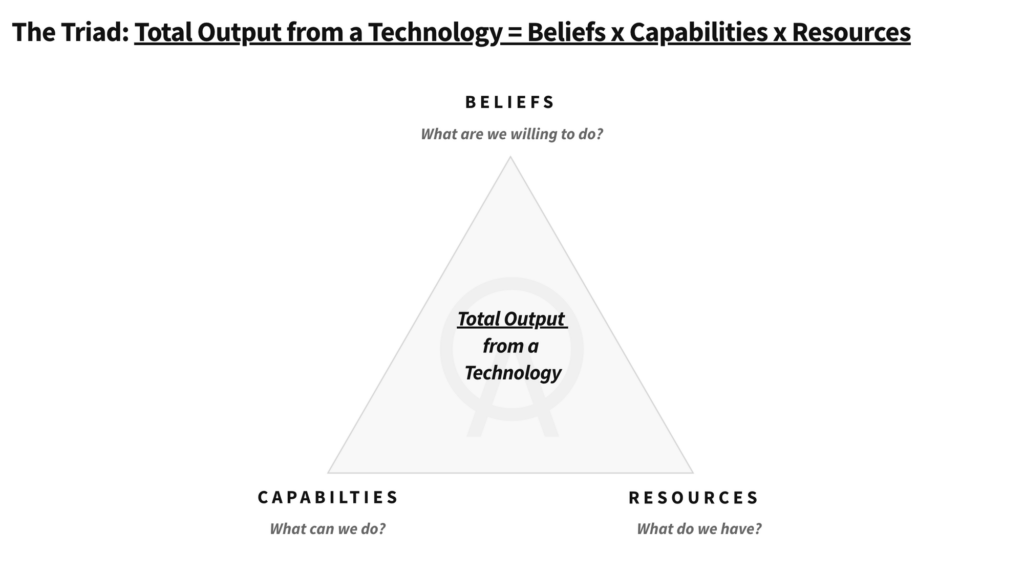
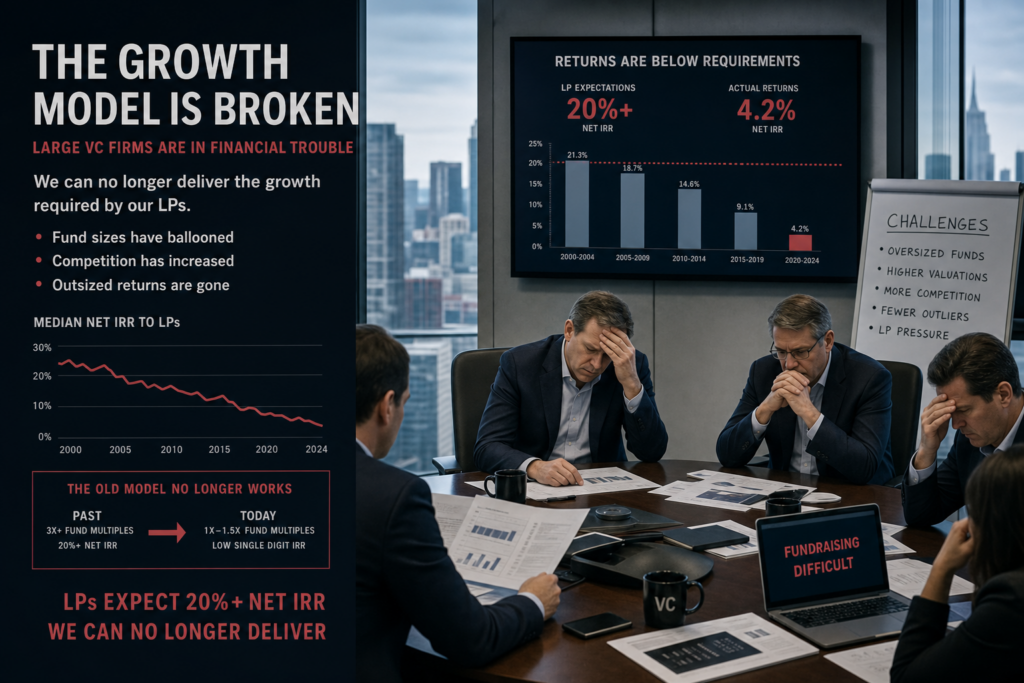
First of all, the problem that everybody is quite frankly facing [because of the amount of debt in circulation] is the lack of growth. Growth is the lifeblood of VC firms that they must see, at all costs, to justify another round of financing to the next stage so they can try to squeeze out their 5-10X returns that make it all worth it. The number of companies that are able to grow exponentially is drying up. There are three factors behind this: People, technology and markets–more on this below.
People were funded on their pitches but not their performance
As a result of drying growth figures, a glut of money has therefore been spent where it’s now remaining stagnant. Remember, smart capital allocation companies like tobacco companies, oil companies, shipping companies, are less concerned in this area since they have the balance sheets or cash flow to support operations–in start-ups, if you’re not growing–you’re dying–and the same goes for investors in these start-ups. You don’t need to pitch a company selling tobacco, but you do if you’re selling online dating applications or the next type of fancy hologram.
In other words, this constraint is related to market in terms of size, its demand, its scalability and appetite. Below I’ll tell you why AI is not shaping up to be the new market.
2.
Second of all, there’s simply not the same number of founders that have the same amount of capabilities as there used to be. This has been chopped up as poor education, or lack of motivation to compete in this increasingly centralized world. Regardless of the reason, this is another pillar that is slowing for venture for a technology to be taken to the next stage and therefore have their big 10-100X return realized.
VC firms if they cannot get growth they will manufacture it with “employee farming”
Despite the internet and the number of available sectors, they’re not thought that they’re being filled fast enough.
3.
Third is the resources aspect. Venture firms constantly want their companies to meet customers or some big names to be able to meet with them and be taken seriously. They want their companies to have “power” to peel out in front of the competition.
They need to be able to have the media capability of getting noticed, to get on the right podcasts at the right time. As you can imagine, companies need more and more money or need to be connected to a lot of money to get this brand recognition off the ground. The problem here that I have been quite vocal about relates to the constant centralization of companies who “matter” in the global economy. Meaning, becoming one of these “powerful” names is increasingly difficult and means less returns for venture investments.
Technology opens up the doors
Even though people, markets and growth prospects may not be very satisfactory, the other pillar of VC success is technology. Technology enables another round in itself of companies to explode out into the market as there is another stair step of development. We can say that the automobile was able to create a whole new form of other industrial opportunities; Uber couldn’t work if the smartphone didn’t exist already; think of all of the number of e-commerce brands if the internet did not exist and so on.
Right now, the glaring opportunity is in the space of AI but there’s a problem.
VC is trapped with AI
Trapped with AI?
Everybody has seen that AI only goes to the moon, right? Let me explain the first problem
But before that…
Are You Interested in Investing for the Long-Term?
Contact me to discuss what services specifically I can offer regarding investment management and advisory in addition to my blogging and newsletter support for you as an investor!

The first problem with VC and I relates to the investments that have been made and the latency effect with AI model advancements. VC have given software coders considerable amounts of capital to code for AI machines to automate processes. Now, AI can code this itself. As a result, what could have costed $300,000 USD for a coder has now become $3,000 with AI doing the coding. Money has been wasted on the software side of development and is never coming back to investors
Moreover, if that isn’t enough, the second problem for those who are making the shift into newer, more swift models–they are discovering that compute power…gets expensive. That is, the tokens for a more precise, lengthy and sophisticated answer costs more and more money. Management decisions are difficult right now.
Lastly, AI’s claim to fame is its capacity to learn and generate new models for further learning. This essentially centralizes great, crisp, accurate information to become better and better. To compete in this arena, you need more compute, better engineers, better code, and invitations to the regulator tables in Congress (or as I say above, you need more “power” to bring your product to the table). As a result, AI is almost ‘so good’ that there is anything but a free market developing inside of it.
Instead, I am incredibly bullish on Robotics
I am looking for great opportunities in the junior mining space and other stocks that we all recognize that are currently out of favor. However, I see there’s a huge opportunity in robotics. Not only because this is a product of mechanical machine learning that form neural networks (a whacky field in itself), but the hardware is increasingly more viable and beneficial with troubled economics, low fertility and a demand for endless convenience. There’s great opportunities that will come forward and hardware doesn’t have the same spending problem as software.
Subscribers hear my top Robotics picks
My Opinion
If you’re a reader of On The Ball and follow our stock picks, you get to see that most of my obscure stock picks relate to some value stock with minimal risk or extreme risk but often related to pharmaceuticals or resource companies (simply because I see an opportunity there). Notwithstanding the latter, I prefer companies that are, for lack of a better term, boring. VC firms don’t like boring. They like “the latest thing” or the “coolest narrative” that supports their investment. To use a baseball analogy, the pitch matters more than the score of the game
There’s about 150 companies a year that matter at all–we’re all fighting for a piece of those- Marc Andreessen
In other words, whether it be the dot com cycle, NFTs, AI era, carbon credits, SPACs, the shift of using a platform for intangibility (AirBNB and Uber do not own real estate or cars, respectively), whatever it may be, their focus is in the next “trend”.
What I see happening is that more and more absurd trends are going to continue as there is a higher and higher necessity to find growth at all costs. This is to kick the bottle of debt down the road just a little bit further. Industries, that may have zero demand or need, may pop up as a place to store the new rounds of credit expansion [for the purposes of servicing the debt loads].
Essentially, VC will be forced to grapple with a “non-sense economy” more and more. As long as the money flows, the fees are taken, the story entertains and the lawsuits stay away–it works.
That is, it works, until it doesn't.
Banks Waking Up
Additionally, because of this reduced amount of growth and expected returns, the books aren’t looking so hot for a lot of VC firms. To compensate, many have refinanced their equity into debt with various banking firms.
However, this has just pushed the problem onto the larger financial sector–now there’s banks effectively holding onto bad VC equity and now they’re reluctant to refinance any further.
VC firms do not get paid if they’re not finding deals and most of the capital invested is not their own. They’re expected to “put it to work”. This comes together to show that they’re heavily incentivized to turnover capital, rapidly.–Paraguay Based Financial Analyst
Overall
Just because there’s an emergence of some very interesting technologies in the world, across a number of sectors–it’s worth mentioning that venture capitalist firms are increasingly hitting a wall in achieving the amount of growth they need to justify more and more investments for their partners. This is a mix of less founders, less growth, a difficulty in achieving power over the market and a technological innovation that is backfiring against them.
In conjunction with a private credit bust which seems likely, I believe we may see a major problem in this private investment sector in the short to mid term.
With this said, I’m always searching out for private investment opportunities, if this interests you, please send me an email