How Often Do You Think of The Roman Empire, Gold Bugs?
Perhaps you’ve seen the trending trend a couple of years back with girlfriends asking their boyfriends or husbands about how often they think about the Roman Empire. To much their surprise, the answers vary from annually, to weekly to multiple times a day. Such a response is baffling to their wives/girlfriends who are questioning whether they even know the partner anymore. But I will ask the same questions to gold bugs who read my site–How Often Do You Think About The Roman Empire?
Doing some napkin math we quickly see that there’s a discrepancy in the value of pure gold today against real items, if we assume that the baseline measure is the Roman Empire, perhaps one of the most influential periods of human history.
Go against the grain...and be patient amongst the noise and chaos by investing with Sea Lion Investment Office https://sealionoffice.com
In ancient Rome, 1 ounce of pure gold (the weight of one modern Gold Maple Leaf coin) was equivalent to roughly 4 Roman gold aurei or 400 silver denarii. By this account, the current ratio of silver coins to one gold coin is quite normal. In other words, relative to current ratio between them, it makes sense.
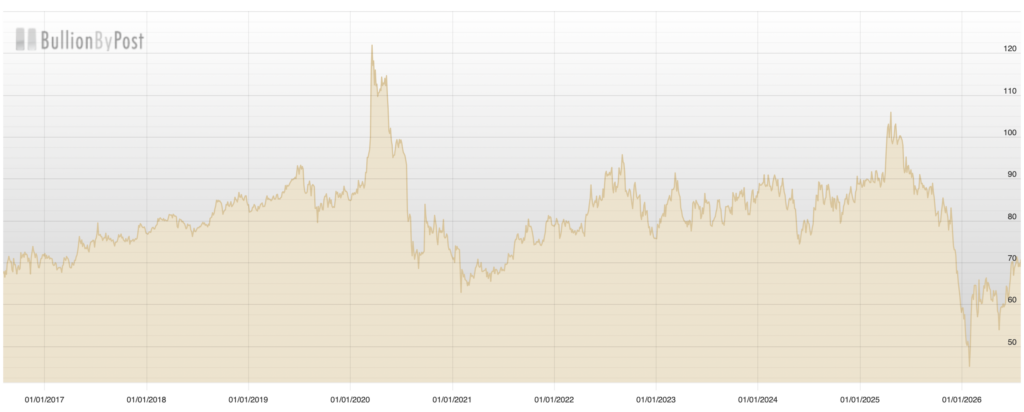
This…is not caught up however
The problem with this ratio is the price–or what each individual coin can buy you.
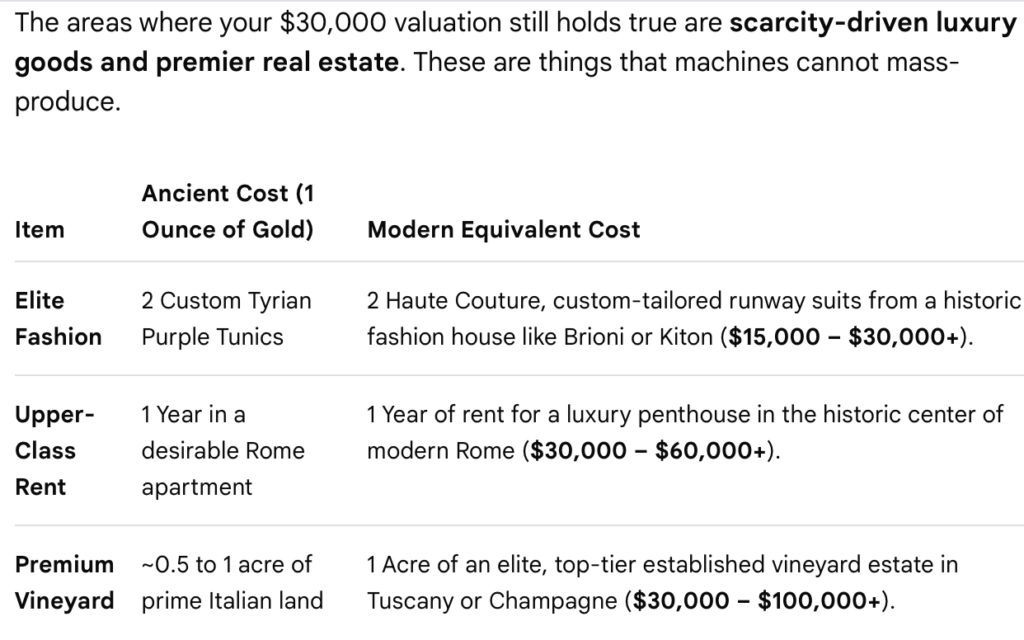
Depending on your needs, 1 ounce of pure gold back then could buy you one of the following options:
🏠 Luxury Goods & Real Estate
- A Year of Fine Living: Rent for a highly desirable, upper-class apartment in Rome for an entire year.
- Elite Fashion: Two custom-made, premium wool Roman tunics dyed in expensive Tyrian purple, the ultimate status symbol of the elite.
- Premium Vineyard Land: About 1 to 2 jugera (roughly 0.5 to 1 acre) of established, high-quality Italian vineyard land.
🌾 Mass Commodities & Everyday Rations
- Grain for a Year: Roughly 80 modii of grain, which was enough to supply a single Roman adult with bread for nearly two full years.
- Bulk Table Wine: Over 1,200 liters of standard tavern wine, enough to host massive neighborhood festivals all by yourself.
- Olive Oil: Roughly 400 liters of standard-grade cooking and lighting oil.
⚔️ Labor & Military Service
- An Elite Soldier: The complete annual salary for a professional Roman legionary soldier during Julius Caesar’s era (about 225 denarii per year), with plenty of silver left over.
- Skilled Labor: The wages of a skilled day-laborer (like a bricklayer or carpenter) for roughly 100 to 150 days of hard manual work.
Right now I don’t have to tell you that each one of these items is vastly more expensive than the single ounce of gold at around $4100 USD at the time of writing.
HNWI and UHNWI; largely the same
Truly Rich (The Senatorial Class)
The hereditary, ultra-elite political class of the Roman world. They ran the government, commanded the largest armies, and governed the richest provinces.
To enter the highest social order in Rome (the Senatorial class), the law required a minimum net worth of 1,000,000 sesterces. In Roman currency, 100 sesterces equaled 1 gold aureus. Therefore, the baseline minimum to be officially considered “rich” was 10,000 gold aurei.
Converting that gold mass into modern terms, a baseline wealthy Roman’s fortune would equal roughly 2,500 Gold Maple Leaf coins, by purity. Which is over $10,000,000 USD right now.
If you wanted to be comfortably wealthy—not just barely scraping into the elite class—a fortune of 4,000,000 sesterces (40,000 aurei) was a common standard for a prominent citizen like Cicero. That would equal 10,000 Gold Maple Leaf coins. or about $40,000,000 USD. Interestingly, the category of Ultra-High-Net Worth individual is grouped as those with 30,000,000 USD worth of investable, liquid assets.
Reality: Most senators were actually worth far more, often possessing fortunes of 5,000,000 to 10,000,000 sesterces (12,000+ Maple Leafs).
🐎 2. The Equestrian Class (Ordo Equester)
The Roman “knights.” They were the upper-middle class aristocracy, wealthy business owners, tax collectors, military officers, and top-tier imperial bureaucrats.
- Minimum Wealth Requirement: 400,000 sesterces
- Maple Leaf Equivalent: ~1,000 to 1,100 Gold Maple Leafs
- Reality: A family with 500 Maple Leafs (200,000 sesterces) was halfway to this rank and lived in absolute luxury compared to the general public.
🏘️ 3. The Decurion Class (Curiales)
The wealthy aristocracy of local towns and cities outside the capital city of Rome. They were the local mayors, city council members, and regional elites who funded local theaters, baths, and temples.
- Minimum Wealth Requirement: Usually 100,000 sesterces (varied by city)
- Maple Leaf Equivalent: ~250 to 270 Gold Maple Leafs
🥖 4. The Plebeians (Plebs)
The massive working class of free Roman citizens. This included shopkeepers, tavern owners, skilled craftsmen (blacksmiths, carpenters), day laborers, and small-scale farmers.
- Minimum Wealth Requirement: None.
- Maple Leaf Equivalent: 0 to 5 Gold Maple Leafs
- Reality: The average working plebeian had no gold to their name. They lived paycheck-to-paycheck on copper and silver coins. An average laborer earned about 1,000 sesterces (under 3 Gold Maple Leafs) per year, which mostly went straight to rent and food.
Interestingly, the plebeian, paycheque to paycheque accounts for around half of the citizenry in the West right now
Story
We’ve seen a massive shift in the purchasing power of human labor.
If you price a 1-ounce Gold Maple Leaf solely by the cost of an ancient soldier’s salary or months of skilled construction labor, it would absolutely suggest a modern gold price closer to $30,000 to $40,000 USD.
Fast Forward from 2000 years ago to 200 years ago
Now if we do the garbage governmental chart of inflation you’ll see that a single coin translates to roughly 26 USD or 34 CAD in today’s dollars. However, this is a phoney number because when you consider the purchasing power of each item, you realize that these numbers are meaningless
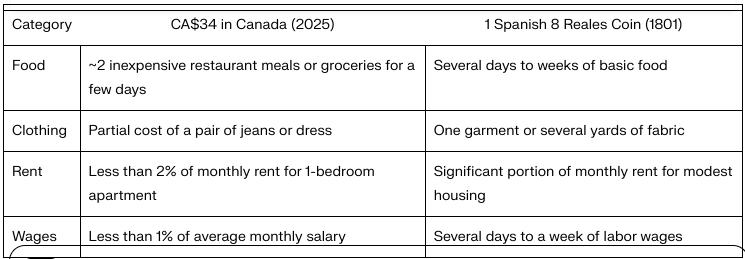
The Spanish 8 reales coin in 1801 had a much higher relative purchasing power compared to CA$34 today. It could cover essential expenses like food, clothing, rent, and wages for multiple days or even weeks, reflecting the lower cost of living and wages at the time. In contrast, CA$34 in Canada today covers only a small fraction of monthly rent or wages and can buy a couple of meals or some small amount of groceries but not much clothing and nothing in housing.
Financial Engineering
With the use of digital markets, fraudulent naked short selling, derivatives, debt and credit based economies, it has created a massive distortion in the involvement of gold against real goods and services compared to historic measures of value.
The olive oil, the worker, the clothes, the land hasn’t changed…but the unit account has changed as we’ve introduced a funny money called fiat currency.
Closing
While girlfriends and boyfriends continue to encounter shock and surprise regarding how often their partners think of the Roman Empire…I hope that this article was another bit of surprise for you. It is a brief article, but the examples are noteworthy. Having ounces of gold that perhaps your friend may have would have historically put them in a significant class of wealth during one of the most dominant and influential eras in human history. Again, it’s worth highlighting that we’re not changing the land, the work, the commodity itself, we’re changing how we think about the value of the underlying gold. As long as we continue to operate with fiat currencies, there will always be a downwards pressure on precious metals as a money–and it will therefore never reach its accurate value.
Sooner or later however, the fiat currencies will break and we’ll only be left with the hard money. Whoever has the gold–wins.
