
Americans; Never Fatter, Yet They’re Starving
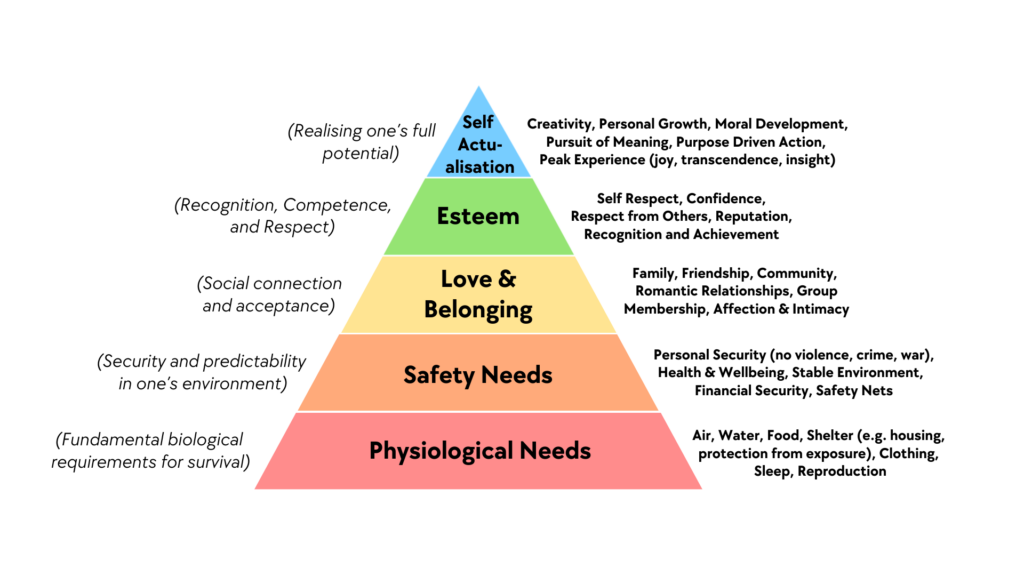
I think it’s worth highlighting the importance of Maslow’s hierarchy of needs to begin. To jog your memory basic to Psychology 1101 class, it is a psychological theory proposing that human motivation is driven by a five-tier pyramid of needs, ranging from basic survival to self-actualization. Individuals must generally satisfy lower-level deficiency needs before focusing on higher-level growth needs and so on. I’ve posted a photo below for you to see. In fact, I wrote an article about this awhile ago stating that I believed the wealthiest people were making their own decisions according to that pyramid, instead of buying a Lamborghini, the newest iPhone, or bling chains to be noticed.
In other words, it had been my own interpretation that the people whom I would regard as being the most knowledgeable on how to create wealth, understood that basics were necessary before this could be achieved sustainably–and what is one those basics?
Food
Now, to scare the hell out of you… I’m going to hit you with some shocking statistics.
- There has now been a continued decline and loss of over 160,000 farms between 2017 and 2025
- The top ~4 meatpacking companies process ~80% of U.S. beef (market concentration issue, not food quality itself).
- In parts of the U.S. Midwest, erosion removes around ~5 tons of topsoil per acre per year, while natural regeneration is extremely slow (often ~100–500 years per inch), threatening long-term productivity
- Roughly ~25–30% of U.S. irrigated agriculture depends on overdrawn or declining groundwater systems, meaning some production is not fully sustainable at current levels.
To double down on the scare, it’s worth highlighting the severity of the Strait of Hormuz being closed. At the end, I’ll refer you to an article I wrote with State Speculator (written by myself) covering some companies that are positioned to benefit from the chaos–but please subscribe by clicking the button below so I can deliver more of these companies to you personally.
News:
- It’s estimated that 78% of Southern farmers can’t afford all required fertilizer this year, the highest of any region.
- Just 19% of Southern producers pre-booked fertilizer ahead of the season, meaning the people that we are reliant on to be always prepared–were not. Cotton, rice, and peanut growers, largely concentrated in the South, barely locked anything in before fertilizer prices skyrocketed.
- Those are also the most fertilizer-intensive crops for agriculture. Rice runs $1,308/acre to produce, peanuts $1,166, and cotton $943, at the current time. U.S. farm sector losses have exceeded $50 billion across the past three crop years.
- Nearly all (94%) farmers say their financial situation has worsened or stayed the same vs. last year.
- Overall, outside of these 3 unique crops, 1 out of 4 American farmers have not secured any fertilizer for their spring plantings.
- Farm bankruptcies to rise 46% in 2025.
- Less than 50% of American farmers will make a profit this year
The No So Great North
In Canada, food insecurity has worsened in recent years. In 2018, 16.1% of the population lived in households that reported some form of food insecurity. By 2023 this had risen to 25.5%. Scarily enough, these are the crooked government statistics (so how BAD are the real numbers…)?
I recently had come across a policy that inhibited the imports of food products from the United States to Canada for zero sensible reason–signaling to me, just like MAID, they wanted problems to occur on Canadian soil.
Found on Reddit:
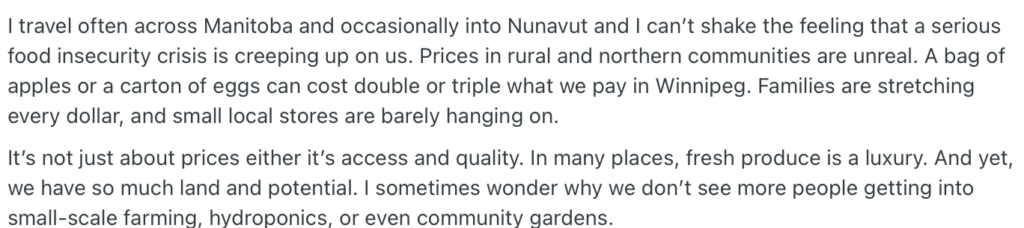
Too Big To Fail (Canada)
One of North America’s Largest Farms Files for Financial Protection. Monette Group, which farms more than 400,000 acres in Canada and the U.S. filed for financial protection and is restructuring.
The company filed for creditor protector in Canada via the Companies’ Creditor Arrangement Act (CCAA) and filed Chapter 15 in Delaware Bankruptcy Court. This is a serious deal since they are one of the top ten global farm operators. Just their cattle grazing licenses alone holds 1.2 million acres of land in Canada.
CLICK THE LINK
https://statespeculator.substack.com/p/three-state-speculator-companies
An Aging Problem
Even if we somehow assume that this won’t amount to anything significant for North American food production– there’s an increasing problem with respect to farmer age.
The average age of farmers in both Canada and the USA continues to rise, with both nations showing a similar aging trend. As of the latest comprehensive data, the average age of Canadian farm operators is 56.0 years (2021), while the average age of U.S. producers is 58.1 years (2022). Both figures represent an increase from previous census periods–and the younger generation are faced with more and more regulatory hurdles, reliance upon state support and are not eager to leave the cities to take up the labour-intensive nature of farming.
Closing
The message is clear–there is a major food crisis taking shape right now and I believe that the closure of the Strait of Hormuz was the domino that has fell first to kick this off. As far as I can tell, those in North America, outside those who are employed in this sector, are sound asleep at the wheel. We can say that they’re operating under the assumption that their Maslow’s hierarchy is as solid as ever.
When in reality… the pyramid is inverted and only very few at the top have secure basics such as food and water. What do you think? I think we shouldn’t take anything for granted.
