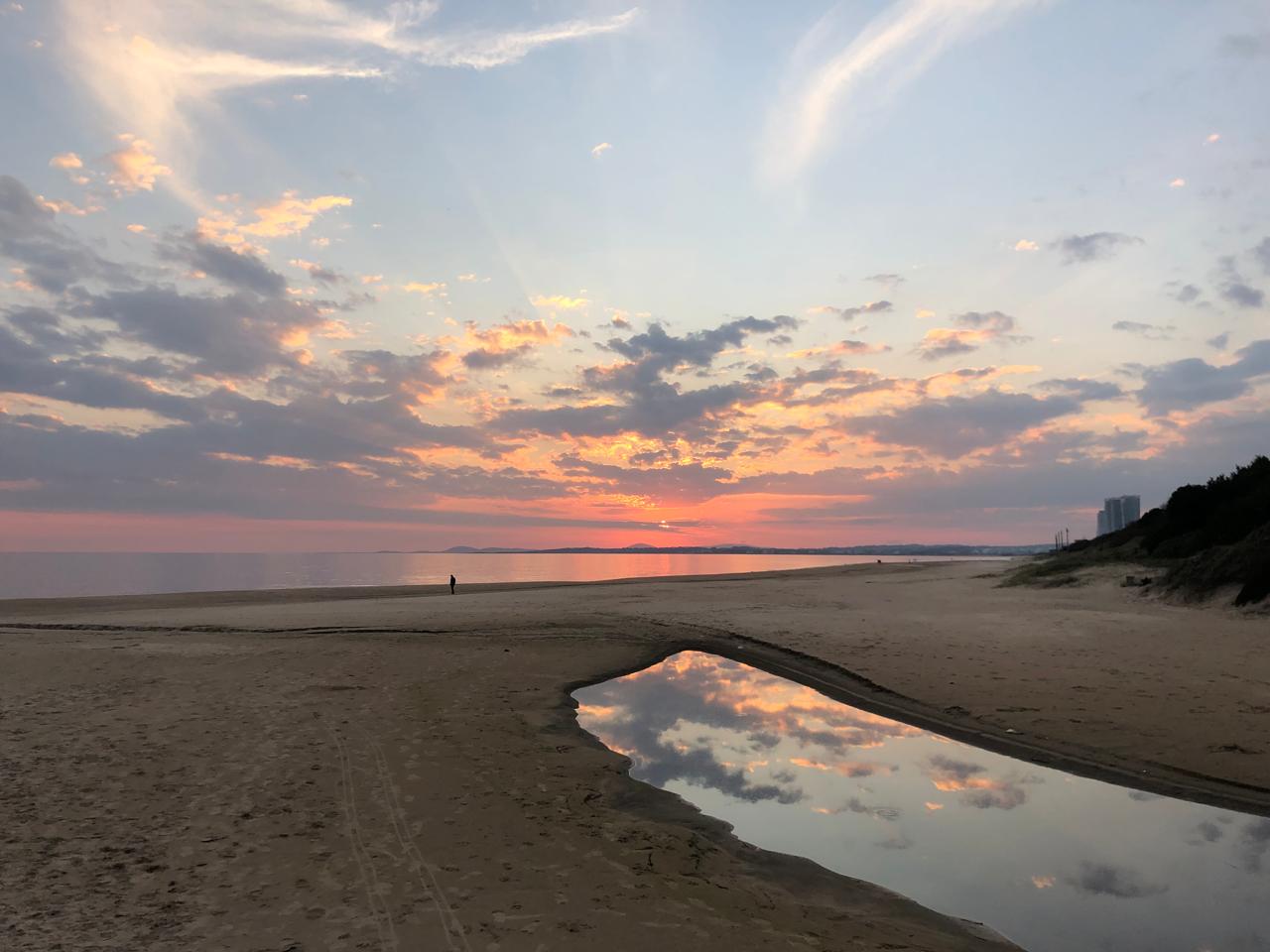
Conversations with a Former Customs Broker/Real Estate Investor in Uruguay
Back in Punta
I returned to Uruguay for a break from the loudness and recent chaos of Mexico–believe me, the added quiet to give me a good sleep alone was worth the cost of flying an entire continent. However, I took advantage even further to meet some great people while down here and one of those so happened to be our AirBNB landlord (contact me for referrals).
It became quickly apparent that he was very well-versed with the economics of his country, the trends with each individual market and the increasing gap between producers, welfare recipients and wealthy foreigners. He also warned me of some bad political changes that are taking place; committed by a government who are determined to destroy what has been good for the country previously (they are a left-leaning government eager to tamper with the economy).
Interested in Uruguay
Residency Help
I have sources that will connect you with professionals who not only work to get you permanent residency but a passport in 3 years (if married)
Top-Notch Real Estate or Farmland
After tracking the trends in markets, there are options to assimilate with residency following a real estate purchase
Contact

First the Good News
Punta Del Este is absolutely rocking. Development is skyrocketing, literally. Since I had been here last I hadn’t remembered seeing so many building cranes + I am aware of a massive Hampton by Hilton hotel being built inside of a new residential area with a mall and conference area (If you’re interested in such an investment, I know the facilitator for this investment where you can own units of the investment trust which owns the hotel; BUT HURRY TO GET IN TOUCH EMAIL CONTACT@IMONTHEBALL.COM). Having said this, it appears that demand for this resort city is still exceeding the supply of hotels and rentals–either demand falls or the supply catches up. So far, the latter is happening.
Now, Punta Del Este is aiming to be a place that people enjoy to live 24/7 as opposed to solely being a holiday destination for the uber wealthy. This is evidenced by the service offering has grown enormously: better schools, more universities, first-class clinics and hospitals, transportation, shops, co-working spaces, and services for residents.
Even if we look at some land prices nearby, I found something very interesting:
"For example, around 10 years ago you could buy a lot in Balneario Buenos Aires (about 15 km from here) for USD 5,000. Today the same lot is worth no less than USD 55,000–60,000. The same happened in Rincón del Indio and in the surrounding “chacras marítimas” (rural coastal lots)"
Still a Raving Party for the Wealthy
Uruguay in the Future
It’s no secret that Uruguay has a low fertility rate, a high suicide rate, emigration and a small population. Naturally, one may think that automation is primed for immediate takeover.
However, my landlord friend had a viewpoint that the 1984 dystopian world was a long way off for Uruguay. Below is what he told me.
“Uruguay has practically no factories; we don’t produce technology, cars, or almost anything with high added value. Our economy basically rests on three pillars:
1. Livestock and agriculture
We produce food for around 40 million people, even though our population is only about 3.5 million.
2. Construction
For the last 30 years, construction has become another major pillar.
3. Public employment
Sectors 1 and 2 generate the money that is then distributed across the different layers of society through public-sector jobs, which act as the main driver of the economy.
Our agricultural and livestock production system is extensive: we release the cattle into the fields and human intervention is kept to the bare minimum. That’s why three people can manage a herd of 1,000 cattle and 1,500 sheep without major problems. The animals are basically free-range. In Argentina or Brazil, production is much more technological and intensive”.
He later states to me that it’s more likely a robot could probably replace a delivery driver, a receptionist, or maybe even a doctor (and in that last case, I’m not sure it would be entirely bad). But beyond that, he didn’t see automation having a massive impact on employment in Uruguay, at least not for now
Pandemic Changes
I’ve found out that habits changed a lot after the pandemic. Many people left Montevideo and moved to areas that used to be considered only “summer towns.” Today many people work in Montevideo but live in places like Las Flores, Bella Vista, Jaureguiberry, Parque del Plata or Atlántida — and in Punta Del Este if they can afford it. Many of them work remotely two days a week: they spend Monday, Tuesday and Wednesday in Montevideo, and on Wednesday night they drive to Punta del Este for the rest of the week.
Place of Potential
“The coastal area of Rocha has much more potential, especially considering the major investments being made in road and port infrastructure. Its beaches are almost virgin. There is still limited service infrastructure, but that is beginning to change.”
Now, some revealing bits
Taxes are a major change that has hit headlines in Uruguayan news (read my article below on this). Uruguay has also had bank secrecy for nearly a century, and residents — both foreign and national — have not been required to pay taxes on capital income or gains from assets and businesses abroad.
Right now the Senate is debating losing bank secrecy, and applying a minimum global tax to foreign companies established in Uruguay’s free-trade zones.
This really changes the rules of the game.
Uruguay Tax Changes. A Must Read
Piriapolis
My friend states “I’ve known Piriápolis for more than 40 years, and my parents for more than 70 years. It’s a beautiful place, but it hasn’t changed or modernized, and public and private services have not evolved in decades. It feels stuck in time. In my opinion, property values there have already reached their ceiling; from now on they will likely only grow at the pace of inflation”
The availability of public and private services is also a key factor. In contrast to Punta Del Este, Piriápolis’ service infrastructure has remained practically the same for decades. If you’re seeking peace and tranquility, Piriápolis is a wonderful place.
If you want a solid investment, I would look at other areas.
Reality of Country
I and many of my friends have noted the idea to sell gold in Uruguay given the relatively poor supply of viable gold dealers. I’ve shared this idea with him and fortunately was met with enthuse by the concept but he highlighted the reality of the average citizen.
“In Uruguay it used to be quite common for people to save in gold coins or small bars. Nowadays, the average Uruguayan has very little – almost no – real capacity to save, and that changes the whole picture.
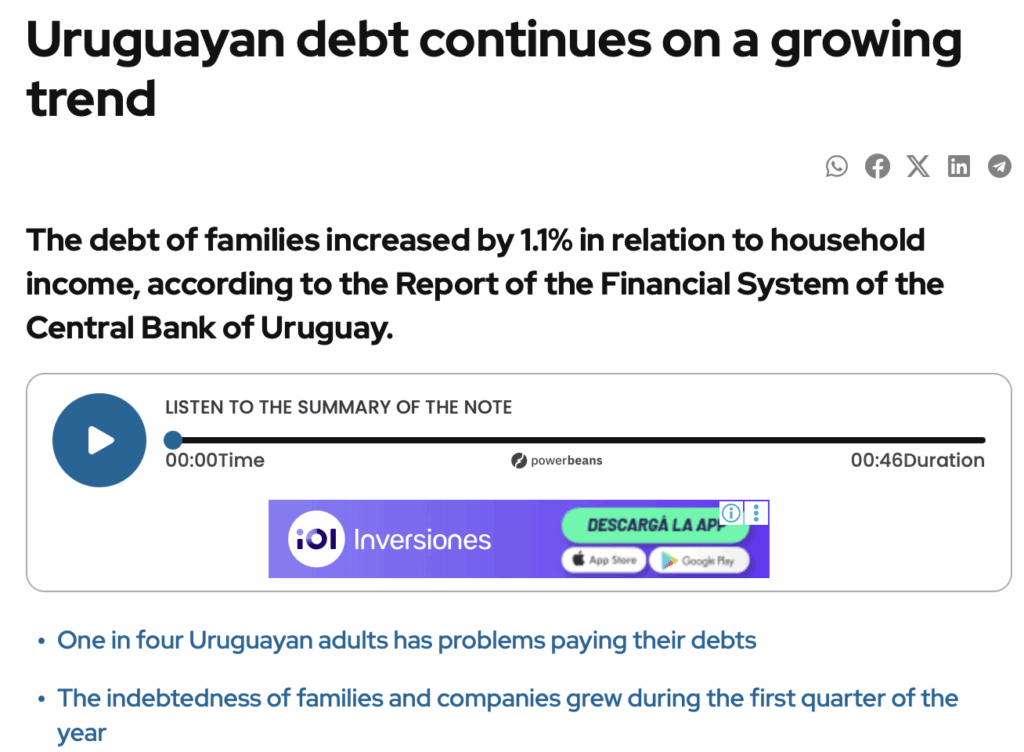
To give you a sense of scale: we’re only about 3.5 million people, and close to one million adults appear in the credit registries, with more than 600,000 classified as problematic or even “unrecoverable” debtors. So a huge share of the working-age population is basically trapped in debt with very little financial breathing room.
At the same time, around 300,000 workers depend directly or indirectly on the State (roughly one out of every six employed people). If you add a heavily indebted private sector, wages that just barely keep up with inflation, and a relatively strong local currency that makes production here more expensive, it’s easy to see why domestic demand and private investment are so weak.“
Interestingly, on the macro side, growth in 2023 was almost flat and there was some rebound in 2024 thanks to a better harvest and more hydro power, but it’s nowhere near a solid, self-sustaining boom–or the lies that immigration consultants feed you. Without new investment and with this debt structure, it’s hard to imagine strong growth in finances for people to have huge amounts for gold investments.
Farming Margins
I’ve also been told that headlines in the country say “cattle is doing great” because beef and livestock prices are high, but the real problem is the margin for local farmers. With operating costs in dollars, bank debt and taxes on top, many producers are working with almost no profit at all he told me.
I was given a sharp example by my friend, “the net profitability of a cattle producer with around 1,500 hectares, good genetics, more than 90% pregnancy rate, doing full-cycle breeding and fattening, on a fully equipped farm (with a caretaker, a farmhand, and the producer himself acting as foreman and agronomist) is on the order of 50,000 dollars a year. That’s AFTER tying up a huge amount of capital in land, cattle and inputs, and carrying all the climate, animal health and price risk… and yet it ends up being less than what a single Uruguayan MP earns in a year, without putting any capital at risk”.
He continued, “For crops the story is different but just as tough. Soybeans, for instance, were trading around 600 USD per ton back in 2022 and now they’re well below that – roughly 450 USD internationally and under 370 USD in the local market. Uruguay’s export prices dropped from about 530–700 USD per ton in 2023 to roughly 410–510 in 2024. At the same time, costs (fuel, land rents, inputs) are not falling in the same proportion. You see the same pattern in wheat, corn and rice: decent potential volumes, but increasingly tight margins and a heavily indebted sector.“
Dollar Weakness
On top of that, the exchange rate has been causing a world of hurt for Uruguayans. The US is pushing towards a cheaper dollar to handle its own debt and Uruguay, instead of allowing a significantly weaker peso (which would improve competitiveness and bring in more local-currency revenue, especially for farmers), keeps the dollar relatively low against it. Together with a heavy tax burden and high operating costs, this really squeezes companies. I have heard of some companies closing up shop and placing their headquarters to Paraguay instead who can operate on better margins.
Many producers are said to be unhappy with the government maintaining a high-interest monetary-regulation of bonds, since now the financial system rushes to buy them, and to do so they sell dollars — pushing the dollar value down artificially even further–creating a loop.
Welfare State Hitting a Wall
Both the current president and the Minister of Economy have openly admitted in press conferences that these changes are being made to comply with OECD and IMF mandates. Uruguay has recently been pressured by international organizations to adopt certain measures, the most obvious of which are a social credit system and universal basic income.
The welfare state in Uruguay is truly hitting a tipping point where there has never been this number of people dependent upon it, at a time when the state is struggling to finance it.
Of course, the welfare state is nothing new in Uruguay, but culturally it is hitting a wall. When you guarantee a certain permanent level of comfort, you inevitably push society toward collapse. You no longer need to make an effort for anything, you no longer need to worry about anything… the only thing that matters is demanding more and more “rights” or “goodies”. He said, “The current generations are comfortable, have a very low tolerance for frustration, and are addicted to technology”
The same thing happens from economics to education. There has never been such a large number of people with university degrees and yet there have never been so many fools. Uruguay now has the perfect breeding ground for the majority of citizens to adopt a social credit and universal basic income system both financially but culturally.

We (this age cohort) are never going to buy Bitcoin or S&P index funds. We buy bricks and metals, or land; we speculate in that space and try to stay as far away from the state’s radar as possible.
The Millennials there, are our Silent Generation, the Gen Z there are our Millennials.
Uruguay is a generation or two behind the United States in terms of their line of thinking. I found out that, “now you go to buy cold cuts and the girl behind the counter tells you how great a time she had in Cancún. She’s wearing the latest model of sports shoes and has an iPhone 16. Her Salary: USD 500 per month…”
Now the younger generation blows what little they have on travel, alcohol and clothes they never end up wearing.
That there is a segment of Uruguayan society — roughly people in their early 40s and older — who are the ones “paying for the party.”
Weird Realization
Uruguay has been described by famous investor and philosopher Doug Casey as being “backward”. This has been off-putting for many who are considering Uruguay as their new home. They assume this phraseology is describing something akin to what European settlors came across inside the tombs of Meso America or the jungles of Papau New Guinea. However, if I fill-in the blanks myself, it would seem that backwards refers to backwards in time, culturally and behaviorally. If I had to put it in so many words, it’s that the 1930s generation in the United States and Canada are essentially the late millennial or boomer generation here in Uruguay.
Much of the area smells of weed…could this explain their amazingly high suicide rate?
Real Estate Research
About Piriápolis, Bella Vista and Solís — if the idea is lifestyle rather than investment, then Bella Vista and Solís are much better choices. They are more preserved, quieter, and still feel like true beach towns. Piriápolis is beautiful, but it hasn’t modernized in decades and the service infrastructure has barely changed. So for living, the areas “behind the main road” or between Piriápolis and Solís can be attractive — but again, more for lifestyle than for investment potential.
Unfortunately, some reforms have the capacity to stall the construction economy.
- several construction and investment projects have been suspended
- the civil construction sector is freezing
- the agricultural sector has a huge debt problem — debt levels are now above 100% of total production, and that number doesn’t even include the large off-the-books debt with suppliers (180-day checks, future-harvest payments), transporters, agronomists, veterinarians, and rural brokers
- recently the cattle sector suffered major losses from Ponzi-style schemes that defrauded thousands of people.
Its true, this government is very left-leaning
Latest Debacle
The Brazilian company Reveillon organized an expensive New Year’s Eve party in Punta del Este with Keinemusic; charging $40,000 per table. It turned out to not only be a waste of money (for this expensive table…but that the event was completely unprepared for the rain that had sent a lot of people heading indoors back to their house/hotel).
Purpose of Writing This
I think there remains a mystery that surrounds Uruguay. Admittedly, it is far away and there is no shortage of incorrect things out on the internet. People who have had a terrible time, or an absolutely fantastic time tend to exaggerate the place without telling the full story.
Uruguay is clearly the best option in Latin America and definitely in the top 10 places globally to be to hedge out more risks that I can count on one hand–so don’t misinterpret this article post. My point in writing this in fact is less about Uruguay in fact, and more so about the fact that most Latin American countries have very nuanced and specific changes happening within their borders. Social inequality is a serious trend on this continent.
In Uruguay’s case, the local population are feeling a bit of a burn. Margins are shortening, input costs remain high or are growing, debts and deficits are growing while a government seems interested in intervening to meet its immediate obligations.
Ultimately, your older hard working, conservative Uruguayans have their eyes and ears wide open–the younger generations tend to be living it up upon welfare, credit and rampant spending while they still can. At the same time, if you read my article on taxes, the upper classes and those with capital to their name are aggressively expressing interest in the East of the country in terms of residency, apartments, land, farmland and frequenting the increasing number of amenities popping up designed to host a year-round audience (rather than simply remaining a resort town for 2-3 months of the year).
Closing
Is Uruguay doing well? It depends where…and who we’re talking about exactly when you want to answer this question. If I provide my own 2cents on the matter (speaking of 2cents, you can find On The Ball provide my 2 cents on Soapbox too)
https://writesoapbox.com/2cents-feed
I can say that I believe the welfare state and big government will always cause problems that are systemic and contagious. Enterprises will suffer, future innovation will dampen, some money will go elsewhere and spending will contract. Having said this, Uruguay’s capacity to fill the need of a wealthier individual or family, will remain intact; it will still be a place where someone can develop their own community, live off the land on sustainable farmland and enjoy the peace & tranquility far from the global chaos. Best find yourself in the latter category while it’s still possible!
#StayOnTheBall