
Aus’Jail-ya With Severe Capital Controls
After doing a bit of research for a client, I’ve found that Australia is creating severe tax changes that effectively trap citizens with their capital (or at least take a huge chunk of it before citizens are able to leave).
First (From DBA Lawyers)
Broadly, from 1 July 2025, the Div 296 tax will apply where a member’s total superannuation balance (TSB) exceeds $3 million and there has been an increase in their TSB at the end of the relevant income year. This movement in the adjusted TSB is termed ‘superannuation earnings’.
While broadly supportive of the principle that tax concessions for superannuation should be subject to certain limits, numerous professional bodies have serious concerns with the following aspects of the new measures: A member will have no ability to withdraw their superannuation balance when it exceeds $3 million and they have not yet satisfied a condition of release, eg, a member who is 50 and has had significant growth in their superannuation assets has no option but to pay the new tax. This is a major change in superannuation policy and submissions have been made that member’s should be entitled to withdraw any excess above the threshold to avoid the tax.
The imposition of a tax on unrealised gains: especially as the new tax will adversely impact those with illiquid assets, such as real estate especially farmers, and who may have no readily available funds to pay the tax. Also, there have been concerns raised that Div 296 will to some extent give rise to a tax on a tax given the member pays tax on unrealised gains and the fund pays tax on realised gains. Numerous professional bodies have submitted that SMSF members should be taxed on actual taxable income or a deemed annual earnings rate rather than being taxed on unrealised gains.
Negative superannuation earnings are quarantined: they can only be used to offset future earnings and do not give rise to a refund. If unrealised gains are to be subject to tax, tax symmetry and fairness suggests that a refund should be provided for any negative superannuation earnings.
The $3 million threshold is not indexed: while the new measure is initially expected to impact around 80,000 members in the 2025-26 income year, with increasing investment values and contributions to superannuation over time, as well as inflationary pressure, over time, many more members will be captured by this threshold.
In short, 3 million (today…) is the threshold that makes citizens wealth subject to unrealized gains; effectively making institutional operations impossible to deploy capital as they’ll always be required to sell more than intended to pay the tax. Eventually, capital, and taxation, runs dry.
Second (Atlas Wealth)
Australians contemplating a move abroad face a critical juncture. Under the government’s proposed Modernising Individual Tax Residency Framework, determining when and how you cease to be a tax resident of Australia is about to become far more stringent—particularly for those leaving for countries without a Double Tax Agreement (DTA) with Australia, like the UAE, Saudi Arabia, and Hong Kong.
The Current Rules: A Murky Patchwork
Australia’s current individual tax residency is heavily reliant on interpretation. It hinges on a combination of four tests but for the time being, people have managed:
- Resides Test – Focuses on behavioural indicators like domicile, intention, family and business ties.
- Domicile Test – If your domicile is Australia, you remain a resident unless you establish a permanent place of abode elsewhere.
- 183-Day Test – If you’re physically in Australia for 183 days or more in a tax year, you may be deemed a resident.
- Commonwealth Superannuation Test – Automatically treats certain Australian government employees as residents.
Although widely criticised for being subjective and inconsistently applied, the current system has one critical feature in favour of expats: it gives you a chance to be treated as a non-resident immediately upon departure if you genuinely relocate and cut ties. Despite the discretionary element to it, the freedom that was possible made it an attractive place to become a non-resident for tax purposes to receive the best of both worlds.
Change
You are physically present in Australia for 183 days or more in any financial year, regardless of your ties elsewhere.
Again, straightforward, but there are new “adhesive residency” rulings. Under the “Ceasing Residency Test”, individuals who have been tax residents of Australia for three consecutive years or more must meet strict conditions to stop being a tax resident immediately upon departure.
The proposal introduces what can only be described as a “sticky” residency status. Once you’re an Australian tax resident, the burden of proving you’ve left—really left—is high.
To Cease Residency at Departure, You Must Have:
- A Confirmed Employment Contract of at Least Two Years
You must be taking up an employment contract outside Australia that is full-time and extends for two years or more. Casual work, freelancing, or open-ended arrangements won’t satisfy this test.- Available Accommodation in the Overseas Location
You must have established or secured accommodation in the foreign country before departure. The ATO expects this to be concrete—think signed lease or ownership documents, not a hotel reservation.- Physical Relocation of Personal and Family Life
Your family, personal effects, and lifestyle must also relocate. Leaving your family behind in Australia weakens your case considerably.Failing any one of these elements means you won’t qualify to cease residency immediately. And if you don’t meet the criteria?
Three More Years of Tax Residency. End of Story.
CBDC + Expiry
Australia has been steadily eradicating cash from its society use for the last 5-10 years to boot. Some instances had banks failing to accept cash deposits or cash as a form of payment, rather asking their clients to resort to digital means only.

The Reserve Bank of Australia, in collaboration with the Digital Finance Cooperative Research Centre, have outlined technical and policy requirements, invited public comment, and launched a pilot program to test CBDC use cases and explore potential economic impacts. In April 2023, Australia and New Zealand Banking Group (ANZ) announced the completion of its pilot project operated by the Reserve Bank of Australia (RBA). In September 2024, RBA concluded that there was no strong case for a retail CBDC, switching to wholesale CBDC development.
The wholesale CBDC is especially relevant with respect to moving capital across borders.
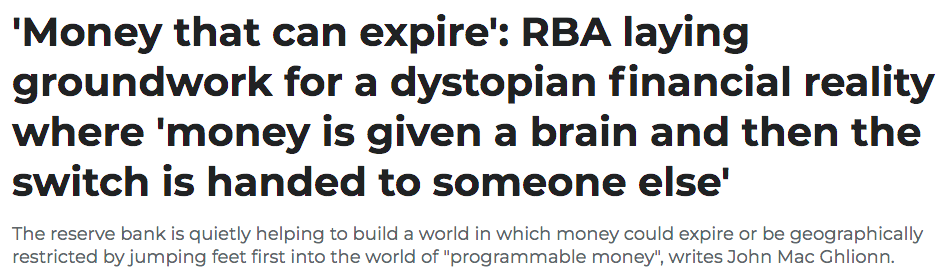
A news post in late 2023 stated:
Without warning all 4 major banks started restricting cash withdrawals in various cities, making some branches “cashless”. The administration took a billion dollars worth of bills out of circulation. Individuals cannot withdraw more than $500.
“Australia hopes to make cross-border payments faster, cheaper, safer, and more efficient with a CBDC. Other use cases and being considered and tested, including offline payments, corporate bond and FX settlement, and more” From Atlantic Council. This means that the new CBDC will likely extend to investments made domestically and internationally; uniting a perfect storm of expiry, forced inflation and forced taxation.
I don’t have to remind you how strict Australia has been during the Covid charade and scamdemic. They were one of the most intense tyrannies in the entire world. In fact the war on cash with new sorts of laws and policies came into full-force during this time for “health” reasons
The idea that money can expire like Chinese social credits is a move that the Western world is moving towards more and more for full political control over it’s citizenry.
Extra
The Crypto-Asset Reporting Framework (commonly referred to as CARF) is a global initiative led by the OECD Global Forum on Transparency and Exchange of Information for Tax Purposes. The rules will require Crypto-Asset Service Providers (CASPs) to collect information on users including individuals’ tax residences and tax identification numbers and report that information to their domestic tax authority. Tax authorities will then exchange that information between themselves to assist with tax compliance, assessment and monitoring.
Australia is expected to join this framework in a complete fashion by 2027.
Future
These people are truly calculating and sinister. My hunch is they will adopt and test expiring digital currency on welfare payments or pension payments first. Most of the general public will agree it’s a good idea for reason X, Y, Z. You can imagine any sort of incentives they can offer (1.5X a payment), 50% off gasoline or groceries with a partnership with a grocery store or the American way of offering donuts to people. There’s many ways they’ll be able to issue digital currencies to better implement these insane tax changes and eventually eliminate savings altogether.
An argument can be made that all fiat currency in itself is a currency that expires given enough time. However what the National Bank in Australia is working upon is another level of dytopia. As though destroying a currency in somebody’s lifetime isn’t bad enough, they’d like to narrow that down to 3 months.
This would mean that each peso, dollar, euro whatever is not fungible any longer because a new dollar or digital currency unit would be more valuable than an expiring currency like a call option. This dynamic, to get the most value while you still can, would force people to spend as soon as they receive their payments. Of course, without the ability to save and a “so-called stimulus” to spend (they never mention that the stimulus involves a gun to ones head), this would end up causing more inflation. This is perfect timing to the save the planet or the White nationalists evil narratives as an excuse to cap ones spending, just like in China. That way, the soup kitchen never runs out of food.
Fundamentally, without the ability to save capital for later investment, you do not have growth, but it goes deeper with that. You do not have the ability to hold together a civilization; transactions is quite literally a free-for-all with criminal actors being the regulating force behind the behaviour. Saving, preserving more for later, is what is necessary as an advancement as a people creating a turnover of buyers and sellers. Australia is determined to make this system a thing of the past so their economy, like everything else, can hit Net Zero.
The problem with Australia is not that it’s a country of convicts, but a country of prison guards
Closing
Well… for Aussies out there. The time to leave is absolutely now. That is, if you value your freedom in the slightest. It should be abundantly clear that Australia is implementing some of the most strict attacks against it’s citizens to salvage what capital remains; it goes from your pocket to theirs.
I believe these changes pair with technology are now a new threshold that will create a massive exodus of motivated and/or wealthy investors with no interest in returning to the land down under (in case they trip the new residency rules). Australia is on the brink of becoming something completely new.
Gives an email or call, mates!
